


Breaking: Thousands Stranded at Abu Dhabi International Airport as Middle East Airspace Shuts Down After US-Israel Strikes on Iran
Flytechnews Aviation Desk
Abu Dhabi, UAE | February 28, 2026 — A sudden escalation in the Middle East has triggered one of the most dramatic disruptions to global air travel in recent years, leaving thousands of passengers stranded at major Gulf hubs — with Abu Dhabi International Airport at the center of the chaos.
As coordinated military strikes by the United States and Israel against targets in Iran unfolded on Saturday, governments across the region reacted swiftly — closing or limiting civilian airspace to ensure safety amid heightened tensions.
✈️ Airspace Closures Ripple Across the Gulf
The United Arab Emirates imposed a temporary, partial closure of its national airspace, citing “exceptional precautionary measures” in response to the military escalation. While airports such as Abu Dhabi and Dubai remain open for ground operations, flight schedules have become highly unpredictable, with numerous cancellations, delays, and rerouted services.
Other countries, including Iran, Iraq, Qatar, Kuwait, Bahrain, and Jordan, also shut their skies to civilian traffic as the situation rapidly evolved.
🚫 Stranded Passengers and Groundswell of Cancellations
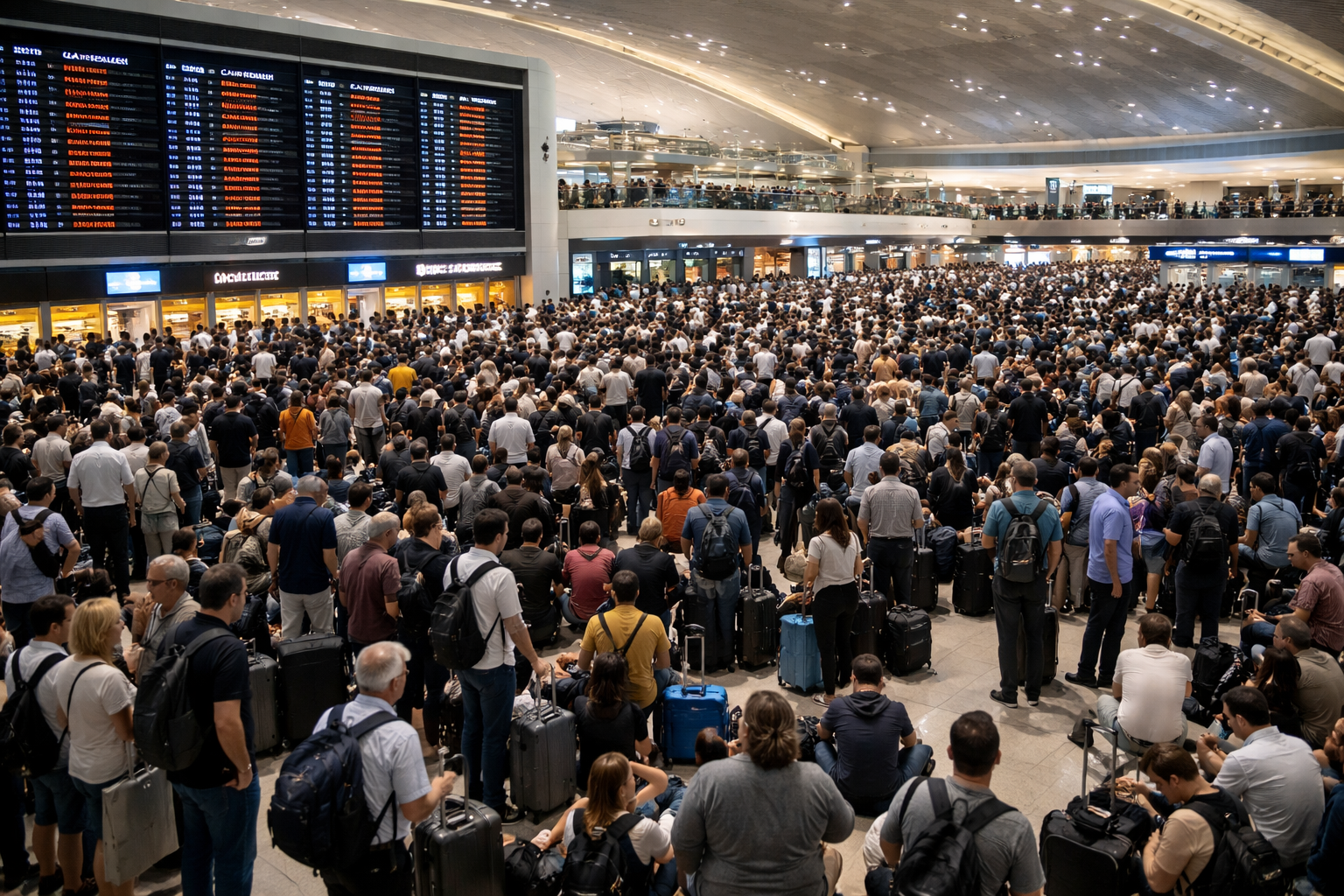
According to travel reports emerging from the terminals, thousands of travellers — many bound for Europe, Asia, and North America — were left in limbo after scheduled departures were scrapped or delayed indefinitely. For many, the airport itself became an overnight waiting room, with hotel rooms in the vicinity quickly booked out due to the unfolding travel gridlock.
Some passengers reportedly spent more than six hours without clear updates from airlines, heightening frustration and uncertainty.
🛫 Airlines Reeling: Cancellations & Reroutes
Global carriers have been forced to respond to the rapidly changing airspace conditions:
- Major airlines including Air France-KLM, Lufthansa, Wizz Air, and Qatar Airways have canceled or suspended flights to and from Gulf destinations, including the UAE, Israel, and Jordan.
- Several carriers are rerouting long-haul services to avoid conflict zones, adding significant time and cost to flights connecting Europe, Asia, and the Americas.
- Flight tracking maps show unusually empty skies over much of Iran and Iraq, a stark visual of how regional airspace closures have reshaped global aviation corridors.
Even flights not directly involving Iran are feeling the impact, with some aircraft turning back to origin airports or being diverted to alternate hubs.
🔗 Government Advisories & Passenger Guidance
In tandem with the travel disruptions, several governments — including the US and UK foreign offices — issued travel advisories, urging citizens to reconsider non-essential travel plans and to stay in close contact with their airlines for updates and assistance.
Aviation authorities are calling for enhanced coordination between international regulators, airlines, and airport operators to manage the passenger surge and mitigate further disruptions.
🔍 What This Means for Global Aviation
This closing of airspace in one of the world’s most strategically important regions underscores the vulnerability of international air travel to geopolitical conflict. For months, flight routes between Europe and Asia have relied heavily on Middle East corridors, and with multiple airspaces now restricted — or subject to rapid closures — airlines are grappling with logistical, safety, and economic challenges.
For travellers, the message is clear:
- Check your flight status with your carrier before heading to the airport.
- Prepare for potential cancellations or long delays.
- Contact airline support for information on refunds or rebooking options.
As the situation continues to develop, Flytechnews will bring ongoing coverage and the latest aviation updates.