


France Unites with Spain and Europe to Accelerate Biometric Air Travel
Europe is taking another major step toward a more digital and contactless aviation experience, with France joining Spain and other European partners in efforts to expand the use of biometric identification and digital identity across the passenger journey.
The move forms part of a broader European push to modernise air travel, allowing passengers to use secure digital identities and biometric verification instead of repeatedly presenting physical passports and boarding passes at different stages of their journey.
France has already taken practical steps in this direction. Since July 2026, travellers using French airports have been able to present their digital identity through the France Identité application when checking in baggage and boarding flights. The system displays essential identification information, including the traveller’s name, surname and photograph.
France is also participating in wider European experiments designed to make digital identity usable across borders. A French-led trial at Marseille Provence Airport explored how passengers could use a smartphone-based digital identity for identity verification, boarding and border-control procedures.
The next stage involves cooperation with European digital-identity wallets and international airports. France Identité said it was involved in an experiment with Geneva Airport to explore how digital identity could become recognised across European and international travel environments.
A passport-free airport experience?
The long-term vision is to allow passengers to complete much of the travel process before reaching the airport.
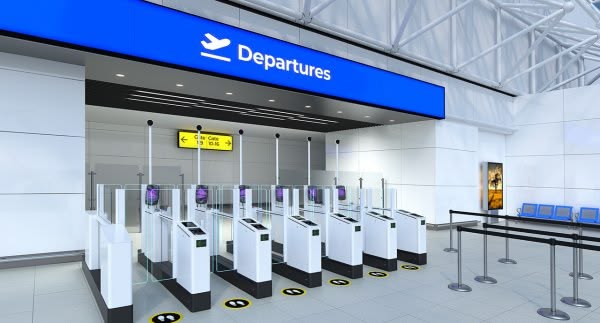
Under the aviation industry’s IATA One ID concept, travellers could verify their identity and travel documents digitally before departure and then use biometric identification at airport touchpoints. This could eventually reduce the need to repeatedly show passports and boarding passes at check-in, security and boarding.
IATA says more than 50 airlines, 40 airports and 25 government entities are already involved in One ID pilots, proofs of concept or implementations.
The technology could also help airports manage growing passenger numbers by reducing manual document checks and improving passenger flows.
🇪🇺 Europe faces an important challenge
The expansion of biometric travel comes as Europe continues to implement its new Entry/Exit System (EES), which uses fingerprints and facial images for many non-EU travellers entering or leaving the Schengen Area.
However, the rollout has not been without difficulties. Several European airports have experienced long queues and technical problems, demonstrating that biometric technology must be supported by reliable infrastructure, sufficient staffing and effective systems.
There is also a major focus on privacy and passenger choice.
On 1 October 2026, ACI EUROPE, Amadeus, IATA, IDEMIA Public Security and SITA announced a new Responsible Biometrics Travel Industry Coalition. The group is calling for European regulations that allow voluntary biometric travel while maintaining strong privacy, cybersecurity and data-protection safeguards.
The coalition says passengers should retain a choice over whether they use biometric services and should have access to non-biometric alternatives.
✈️ The future of European air travel
France’s growing use of digital identity, alongside initiatives involving Spain and other European partners, highlights the direction in which the continent’s aviation industry is moving.
The goal is a journey where a passenger’s identity can be securely verified digitally, reducing repetitive document checks while allowing airports and airlines to process growing numbers of travellers more efficiently.
For passengers, the future could mean spending less time presenting documents and more time moving through the airport.
But Europe’s biometric aviation transformation will ultimately depend on finding a balance between speed, security, privacy and passenger choice.